Today predictions. Tomorrow, all markets.
Why the next generation of personal finance won't look like an app you tap. It will look like an institution that runs itself for you, in your name, while you sleep.
The hedge fund used to be a place. A building full of analysts, traders, risk officers, and a wall of screens. To run one you needed capital, a license, and the right last name. The barrier was never intelligence. It was the operating stack.
That stack now costs almost nothing. The whole operation is a single AI. Your CEO. The desk is plain text you can read and rewrite. The guardrails are many and named. The Chair, the one who sets direction and reads the reports, is you. The fund you can run today, alone, from a quiet room, was a hundred-person operation a decade ago.
A fund that runs itself doesn't just save you time. It does the things you would never have done by hand.
It places the bet you would have hesitated to take. It holds through the day you would have panicked. It tries the small experiment you were curious about but never had the discipline to run. The Chair commits to ideas. The CEO commits to executing them. The gap between knowing and doing, the gap that breaks most traders, is the gap it closes.
Then there is the part no demo can show: the strange pleasure of watching it work. You read the dossiers your CEO builds. You see the bets it placed, and the ones it passed on. You watch what the week won, and what it lost. It grades its own work, cycle after cycle. Every success teaches it, every loss does too. You sharpen what hits, retire what doesn't, and slowly, in a way no spreadsheet could show, the fund becomes distinctly yours.
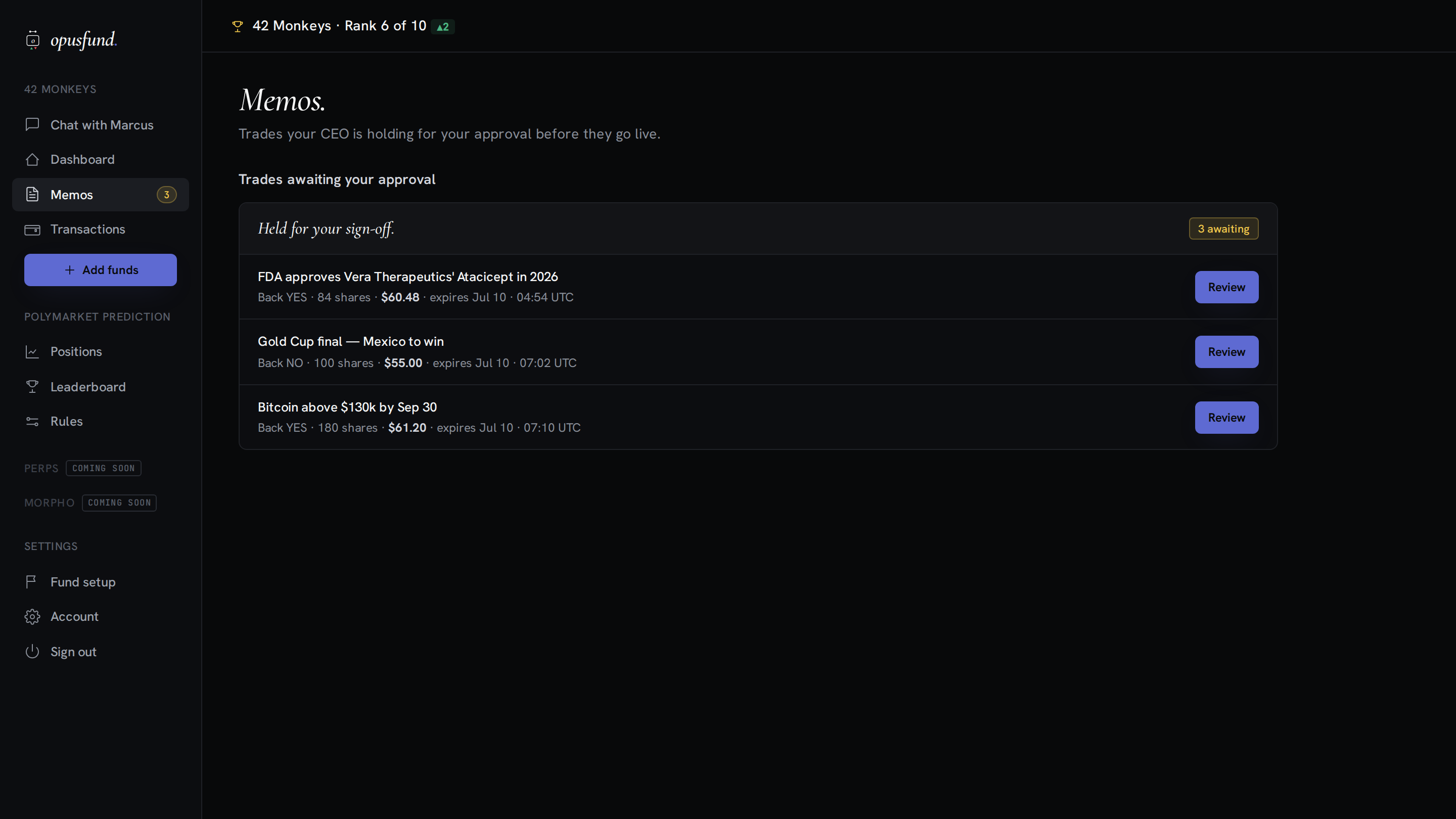
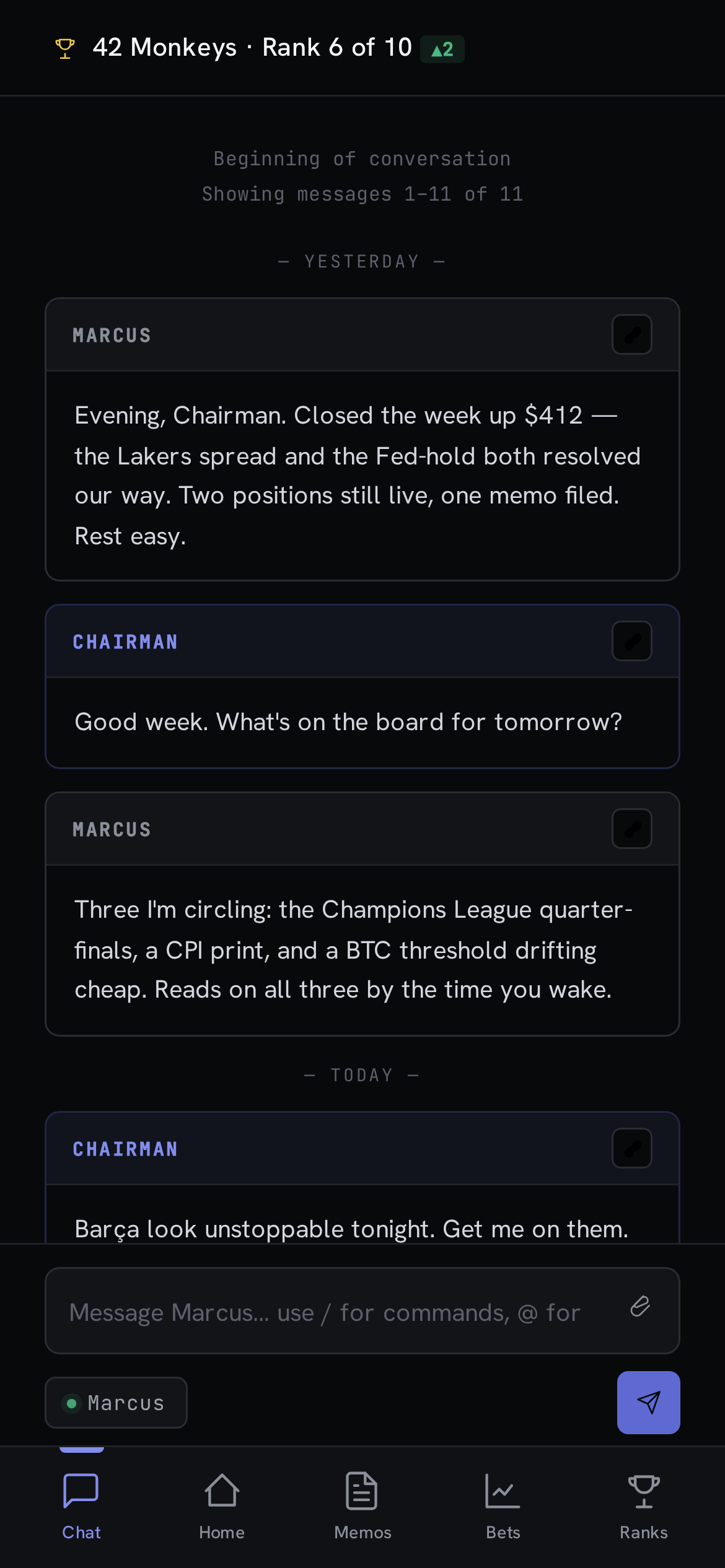
We start on Polymarket
We are starting on Polymarket because it is the right first room. Every market is a real question. Every price is a real probability. The resolution is written in the rules, not in someone's quarterly opinion. A new fund needs a clean place to learn its hands.
But the architecture has no allegiance to one room. An Opusfund will not live in one room. It will work many at once, hunting a mispriced election here, reading a lending pool there to see which dollar earns the most this week, watching a derivatives market for an opportunity too clean to ignore, reading the rules of a new market the day it opens to find the gap before the crowd shows up. Every room with its own edge, and one CEO moving between them.
And the rooms speak to each other. When the fund wins on an election bet, the profits don't sit. They flow into the base the Chair has named: Bitcoin, a yield-bearing dollar, an index of crypto. When an event on the calendar looks promising enough to deserve more, the fund borrows against that base to put more on the line. When edges go quiet for a week, capital migrates into yield until they come back. Every win compounds the next round.
The Chair never trades. The fund never sleeps.
This is the bet behind Opusfund: that the next generation of personal finance will not look like an app you open to tap a buy button. It will look like an institution, quiet, plain-spoken, autonomous, running itself for you, in your name, awake while you are not.
Today, one room. Tomorrow, the whole house.